Pages

Wednesday, January 30, 2013

After This: Authentic and Catholic

*Spoiler Alert*

I'd like to say I've been at a loss as to what I might write about our January selection, After This, by Alice
McDermott, but that would not really be the case.   Instead of loss, my hesitancy is caused by gain--by an abundance-- of beauty, truth, and strength.   This book is so beautiful and so close to perfection that it almost seems like a violation to approach in terms of review or analyzing.   I finished this book being truly awestruck by a writer whose talent goes beyond great to the level of literary genius.
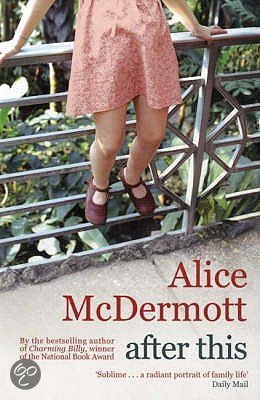


After This defies categorization for me.   It is not a traditional plot-driven novel with a recognizable problem and resolution.   It is character-driven, with the Keane family made up of parents John and Mary, along with children Jacob, Michael, Annie, and Clare, being the focus.   The family members are fully developed by McDermott through their words, spoken and unspoken, and their interactions with the people and places around them.   McDermott's words are sparse, but powerful and so loaded with information that it is sometimes necessary to read sentences and whole passages more than once.   Such re-reading is not arduous, though, but instead is closer to excavation, as with each new dig the reader discovers some new detail that adds to the experience of revealed treasure.   Another feature of After This is McDermott's ability to make the reader feel like he has intimate knowledge of each character and moment whilst simultaneously being a distant observer of an expanse of time, much as we might consider the lives of acquaintances and neighbors.   After This is a period novel, set in America during the post-war and Vietnam eras and yet it speaks to the changes, hopes, and concerns of today.   We recognize the images of the past, but all of the thoughts and actions of the characters could easily be placed in a current setting.

In reading biographical information about Alice McDermott, I found out that she, like the Keane children, was raised in an Irish Catholic family in New York.   This book is a thoroughly Catholic book in its appeal, style, and themes.

After This is universal in its appeal.   Anyone can relate to these characters and to their lives.   The Keanes and their friends are normal, flawed people who have what is necessary, from within and without, for both good and bad.   John and Mary Keane love their children and they worry for their futures.   The Keane children love their parents, but must face the usual challenges of facing the world as individuals and deciding what to keep from the past and the present.

In several passages, John's fear of his daughters is expressed as he feels such love for them, but often doesn't understand their feminine ways.   After his youngest daughter, Clare returns from an excursion to see a play in the city, John sits, trapped by a contraption of his own means that is an attempt to heal his aching leg.   She recounts the dramatic details of the play as he observes the young lady she has become.   The feelings possible from any father of a girl are expressed in this short passage.

She paused.   Looked at her father and shrugged.   he suddenly realized that she was about to cry.
"That's too bad," he said.   he knew enough not to laugh at her.   He had already offended her, more than once, when he'd teased her about her easy tears....
And then, to his great surprise, she began to sing.   her voice was sweet, lower than he would have expected, although surely he had heard her singing around the house a thousand times before.   But now she was singing for him, much as she used to do when she was very small, her hands at her sides, her eyes half closed.   The cotton shirt not too long, perhaps, but wrinkled front he hours she'd been sitting.   The little-girl knees, although her body was growing lean.   She sand and he was both enchanted and embarrassed by her earnestness.   Both hopeful that neither of the boys would come upstairs (Jacob would only roll his eyes but Michael would sing along with her, mocking, howling the words to run, where the brave dare not go ow ow) and yet wishing that they would because there was something painful in it, watching her, another kind of pain altogether than what he'd been fighting these past two days.   The boys had their lives off in the wider world, he thought, but girls, his daughters, they had their lives far wider and far more inaccessible, right before his eyes.   

In meeting to discuss the book, our book club members expressed enjoyment of the details of the Keane's house, its normalcy and homeyness easily related to our own.   Also, the relationships between the siblings were authentic with their interactions which where a delicate balance between antagonistic and loving.   

In addition to its universal appeal, After This is Catholic in its style.   This is not a dialogue-driven piece.   Characters do not work out their problems or thoughts through detailed conversations.   There are no monologues which declare to the other characters and the readers what thoughts are taking place.   Instead, with a Catholic sensibility for relating to others through sign and symbol, McDermott chooses words with artistic precision to illustrate using characters' thoughts, clothing, surroundings, and closest friends.   In one passage, Mary has come home from the hospital, with baby Clare in her arms and her other three children overjoyed at her return.   They only know how to express their love by acting as if they hated Pauline during the time she baby-sat them.   It gives insight into the workings of childrens' minds and what must have been the nurturing motherhood of Mary Keane.   Instead of conversations or vignettes of family scenes, this is how McDermott tells us what kind of mother Mary Keane was to her family.

It wasn't that they'd found Pauline unlovable.   The entire world of adult strangers was more or less unlovable, with their huge earlobes and their smoky breaths, their yellow teeth, their intrusions.   It was only that the house was empty without their mother in it.   Recognizable still in all its familiarity: the vestibule where they dropped their book bags and (at Pauline's insistence) hung up their coats, the living room where the slipcover was newly dark, the cluttered dining room, the Formica counters in the kitchen, the Dutch Boy cookie jar, the worn carpet on the stairs, the sunlight through the windows of their bedroom which seemed always, from the time they woke until darkness fell, the sunlight of four thirty in the afternoon, all of it familiar but seen, for the first time, as it might look when it was empty, with none of them there.   This both puzzled them (because all three of them were indeed there, and Pauline was there, and by nine o'clock each night when visiting hours at the hospital were over, their father was there) and filled them with despair, which was what made them tell their mother, once she had returned, the baby in her arms, that they hated Pauline.   That they hoped they would never be left in her care...
It wasn't true, they hadn't hated her at all..., but it was an explanation that lingered, a conviction they would share for the rest of their lives.
 
Also, McDermott handles time in a very Catholic manner.   The Church teaches that God exists outside of the constraints of time.   He is not limited to the constraints of time.   We, with our feeble attempts, use the boundaries and markings of time to make sense of our world.   To bring about order.   McDermott has a way of referencing the past and future in the midst of the present without the use of flashbacks.   It is fluid and aided by combining the intimate with the distant.   Just as we understand that our prayers can have affect on the future, we see in After This how moments have significance and affect on the past and present.   In a favorite passage, Jacob and Michael walk ahead of the family after the first mass held in the newly renovated church.  They joke, tease, and even manage to share some secrets with each other in this rare instance of being open with each other.   McDermott writes beautifully, with her ability to be intimately up close with a character while relaying it all as an observer who sees from a distance of both location and time.   Any reader can find himself in this transition from childhood to young adulthood.

The route was all familiar--gray sidewalks and driveways, green rectangles of lawn, cars, bicycles, houses and trees.   The familiar streets.   He and Jacob could name nearly every family as they passed.   The O'Haras' house, the Krafts', the DeLucas', Levines', Perichettis'.   They'd been in most of their kitchens or front hall-ways, they'd collected paper-route payments or candy on Halloween, gotten glasses of water or Kool-Aid from them on hot summer days.   As he walked beside his brother, Michael's recollection of these days made them all seem soft-focused and gentle, an easy roundness about things that had since given way to something thinner, something grown sharper in threadbare sort of way.   Maybe it was the clean-edged aluminum siding that had replaced the aging shingles on most of the homes, or the sleeker cars, or the sun catching the chrome on Tony Persichetti's motorcycle in the driveway, where he once would have left his bike.   Maybe it was just the sense of it coming to an end, his time in this place, his childhood.   Maybe it was that the place had worn thin only for him, that he was already worn out with waiting to leave it and get on.   

I would also submit that this book's Catholic style can be seen in the way good and bad are portrayed realistically.   The difference between sin and virtue are shown in a subtle, artistic manner.   Characters who sin are not automatically smote by God.   The sadness, scars, and effects of sin are left for the reader to realize, amongst the actions of life.   Is that not how it happens in real time, in real life?   It would be a disservice to only portray extreme examples of only virtue or only sin and then show clear-cut immediate consequences of those actions as being easily identified to everyone.   It would be as misleading as Annie's friend, Susan's father, who would sit on the couch in months to come, bidding his sweet innocent daughter a farewell, while being unaware of  recent events and the way they changed his daughter forever.   A few weeks ago, as a friend and I discussed the movie we had just viewed, Silver Linings Playbook, we expressed a common feeling that while we loved the world of period dramas such as Pride and Prejudice or Downton Abbey, sometimes we needed to see well-done films in a form that looked more real and more relevant to our own lives.   McDermott uses contrasts and inner thoughts to illustrate the reality and effects of sin.

If the event of Susan seeking an abortion had been written from a Puritan standpoint, I think there would have probably been two possible story-lines.   One, Susan would have been saved from the abortion, either by a last-minute persuasion by Annie or by harsh treatment by the abortion clinic staff which would shake Susan into a realization of what she was doing.   Two, Susan would have had the abortion and then died from it or been seen later in the novel as psychologically traumatized or unable to bear children.   It would have been cautionary hellfire and brimstone in novel form.   Instead, I see McDermott's treatment of this event as much more powerful.   I cried and I still can't get it out of my mind.   My heart aches more for Susan and for Annie in her involvement much more than it would have in either of the two story-lines above.   We have Susan first coming to terms with her abortion.

If Annie hated her for what she had just done, Susan thought, then she would be alone in the world, as lost as her crazy brother screaming in her dreams...

Then, sitting in a diner with what would normally have been a fun meal of perfect hamburgers and egg creams with her best friend, we find them unable to eat, as Annie tells Susan she "lost it" and had to leave the waiting room.

For Susan, the thick pad and cramps and the terrible word--curettage--that set her teeth on edge, all gave way to the sudden descent her heart took.   If their places were exchanged, Annie wold not have done what she'd done.  And there was no undoing it.   

Then, Annie proceeds to tell Susan that it was the events of the book she brought along, A Farewell to Arms, that had caused her to cry in a bathroom stall for twenty minutes.

Intolerable and terrible and made even more so by the fact that within the same hour of her reading, the book had convinced her (there in the softly lit waiting room of the abortion clinic) that despite war and death and pain (despite the way the girl with a woman who might have been her mother seemed to gulp air every once in a while, a handkerchief to her mouth), life was lovely, rich with small gifts: a nice hotel, a warm fire, a fine meal, love.

And then comes what breaks my heart because it is so tragic and so real.   Teenagers who have sought answers within themselves instead of turning to God or to trusted adults.   Trying to convince themselves, trying to dust themselves off and move on, without pain or guilt.   An attempt at justification we have all experienced at different points in our lives, but particularly during our formative years.

Annie threw the balled-up napkins onto the table.   "Christ," she said, "what is wrong with them?   Why do these crazy women want us to read such depressing things?"
"They want us to suffer, " Susan said, sarcastic so that Annie wouldn't see how much she wanted to cry.  "They want us to be afraid."
"They want us to be nuns," Annie added, so she wouldn't have to say, Oh, Susan, oh, my poor friend.

And in that last exchange between the girls we know.   We know the pain and guilt that will haunt Susan.   We know that Annie wouldn't have done that and that she knows it was wrong.   We know that she feels guilty for her involvement and late realization.   We just know, because we are intimately familiar with childish logic and as adults we are all too aware of its consequences. 

 The themes of this novel are unmistakably Catholic, and therefore, really, they are classic.   The theme of a full life is delivered through the major events of this novel which usually deal with sex (and childbirth) and death.   Always, there is a common intertwining between pain--not always in terms of being hurt, but sometimes in sweetness of ache-- and pleasure, joy and sorrow, not presented as some sort of lecturing illustration, but as a true depiction of a life fully lived.   A full life is an open one, an openness that cannot be selective in regards to suffering without also closing itself off to the fullness of love.  Christ on the cross.

We first see a glimpse of this theme as we are introduced to Mary, who, in her early thirties, seems destined to be single.   We are along on her date with George and then there on the following morning when a handsome stranger stands waiting for her at the door of her usual lunch spot.   

Only him, again, leaning by the door, suit jacket and fedora, the sunlight striking gold, the leg he had favored bent back and pressed against the building.   He was smoking a cigarette.   He was the handsomest man on the block.   He was waiting for her.
She felt Pauline beside her, stiffening against his greeting .   She thought, giving him her name, how there was a trace of sorrow in every joy.   She thought, as he held the door, smiling at her, Poor George.

You can further see this theme in comparing the love scene between the married John and Mary which occurs toward the beginning of the novel (the baby grand) to the scene of Michael and Beverly, when he recalls the words of a prayer.   Compared to the range of emotion and experience of his parents love which ends with them sharing tenderness, we have Michael and Beverly, speaking of nothing of consequence with only alleviation of boredom and attainment of pleasure as their goal for joining.

She only stirred and then slowly climbed over him, spreading herself over him, no weight at all.

There is McDermott's description of my favorite piece of art, Michelangelo's Pieta, as seen after a long wait in line on a hot day.   Once inside the cold marble is before them as the air conditioned air now makes them shiver.

In the absence of all color and all other light, the white marble held every nuance and hue a human eye could manage.   Here was the lifeless flesh of the beloved child, the young man's muscle and sinew impossibly--impossible for the mother who cradled him--still.   Here were her knees against the folds of her draped robes, her lap, as wide as it might have been in childbirth, accommodating his weight once more.   Here were her fingers pressed into his side, her shoulder raised to bear him on her arm once more.   Here was her left hand, open, empty.   Here were the mother's eyes cast down upon the body of her child once more, only once more, and in another moment (they were moving back into the darkness) no more.


In contrast, we are given the character of Pauline, Mary's former co-worker who becomes an extended family member.   Pauline has had a hard life.   She does not go to church or seem to have any real belief in anything beyond what she can plainly see before her.   Her attempts are always directed at control, order, and safety, all pushed to the limits in an attempt for an imagined perfection.   We alternate between feeling Pauline is pleased with her arrangement and that she finds much loneliness and despair in her life. She is guarded.   She is closed.   In her effort to save herself from pain and discomfort she has also closed herself off from pleasure and joy.   She, like us, cannot escape the messiness of life and we see that she cannot escape suffering, but hers is even more keenly felt because it does not have joy as a counterbalance.   

Another theme explored is the Catholic balance of the old with the new.   This is a greater problem for the Church than any other institution due to its existence for over 2000 years.   It is understandable in smaller portions, though, as McDermott illustrates the American eras in which the novel is set.   We see the changing face of war, that continues today.   A relatively large portion of the book takes place at the beginning when the Keane family takes an impromptu picnic on a Sunday during an approaching storm.   Michael and Jacob play out the battles of World War II with their toy soldiers in the midst of this ordinary scene of family life.   It is play full of heroes, bad guys, and recognizable goals with measurable results.   It represents the nostalgic view of World War II that became a part of American culture.   The Vietnam war, however is portrayed in the stark rawness of Jacob's life being lost and Tony Persichetti's breakdown upon return from his tour of duty.   The mere mention of the Vietnam War leads to argument or silence on the part of those for whom the tragedy is just too real.   Too real to expose their loved one's memory to debate.

Then, there is the center of the novel.   The center of the family, the center of their world.   Their Catholic parish.   Their church, St. Gabriel's, first introduced as a traditional building showing signs of age and later taking the form of what Jacob would think of as a "flying saucer" from an airplane taking him to Basic Training.   The excitement of raising funds to give the parish a new place to worship.   The good intentions.   Then, the disappointment as something seemed missing, from the moment the old building was demolished.

In the days before the dismantling and after the demolition itself, McDermott lets us know the place the parish building held in the hearts of the Keane family.

A rumor spread among the younger ones, Clare Keane included, that the unused staircase at the back of the church, with its wide marble banister and its velvet rope (and its scent, when you got near it, of incense and attics) was an entrance to heaven.

The descriptions of the workmen carrying out the last statues and pictures while the school boys watched were beautiful.   Jacob watched it all with the other boys and

...swore that the smell of incense still came from the hole where the church had been.   He made the other boys pause and sniff the air.   Yes, they nodded, their chins raised, they could almost agree.

I think it's significant that it is Jacob, with his Jewish name, who senses a loss from the past and leads the others to notice it.   Jacob actually plays a role throughout the novel in giving other characters pause to look at things differently.

Now, I know some think I should read into the new parish building all the horribleness done in the name of Vatican II.   I should decry churches without altar rails and say that we are in the mess of modern society today because the people built modern buildings and we can't have authentic Catholic lives without Latin and buildings built from yellowed architectural renderings, but the aftermath with which we are now faced  is more complicated than that.   I see Latin mass as the most beautiful form of worship we can accomplish on earth, but since one of the major reasons I am Catholic today is my belief in the authority of the Church, I accept that I can worship in the vernacular without getting angry about it, since the Church says it is licit.   I love my parish building with its modern space, its ceiling that looks like the hull of a ship and never fails to remind me of the fulfillment of God's promise he began with Noah and the safe haven of Peter's Barque.  But, I also love visiting the adoration chapel of a local church, with its abundance of dark stained wood, statues, stained glass, and lingering smell of candles.    I often let my mind drift to memories of worshiping at the Cathedral in Liverpool, England.   It's a modern structure formed of massive amounts of concrete and stylized stained glass; it has been a topic of controversy since it was completed.   It is breathtakingly, achingly beautiful, with its ceilings' skeletal structure made to represent the Crown of Thorns.   The beautiful side St. Joseph's altar, made from carved wood elements.  It takes up a huge amount of the skyline of Liverpool, and like a nun's habit, when you look at it, no matter what your background, you stop and think of God.   And I loved the glorious churches from previous centuries in all their beauty and glorification of God.   I love them all because I can go to all of them to receive the Eucharist.   That's what matters most to me and I am so in need of Christ in the Eucharist that I will go to any of His sanctuaries to receive.

Interior of Liverpool Cathedral.   That's stained glass, not neon.

Interior of St. Etheldreda's in London

 The new St. Gabriel's seems to resemble the outside world of the characters.   It is more and more unfamiliar and less beautiful, but inside it, they can still find God in His Truth and Love.    The familiar has been taken from the parish, so that their homes become the only refuge in the chaos of the era in which they live.   


In her descriptions of the new building, we get a sense of true loss and diminishment, there is no doubt, but  McDermott manages to show the attempt to  reconcile the old with the new and make us think of our attempts to do the same.

Beside her, her husband noticed how the new pews lacked the small brass hat clips that had been secured to the back of every pew in the old church...He understood there was no longer a need for them--so few men wore hats anymore (he blamed JFK with his thick hair and his big Irish head for changing the fashion)--but the lack of them added to his dawning sense that the new church had turned the stuff of his past, his own memories, into something quaint, at best.   At worst, obsolete.
And yet, the smell of the incense from the center was the smell of the incense of the old, and the stately movement of the priests in their robes as they walked down the aisles swinging them, sending the pale smoke into the air, their free hands placed gently over their hearts, was as it had always been.

No matter how far the architecture wandered from the past, the central purpose of the building, the mass, was still there.   It exists regardless of the surroundings or the changing times.   So, it is for the truths taught within the parish's sanctuary and its school walls.   We see this later, with Michael as he is faced with navigating adulthood away from the safety of home.   

They were lying side by side, naked in the dark, and the old house, as it did every night, was steadily growing colder.   The drawings made him think of the satyrs and nymphs on Chris's dope box and then of Caroline opening her parka for Ralph, that motley crew of cherubim and seraphim all around her.   Hail, Holy Queen, Mother of Mercy.   Our life, our sweetness and our hope.
He thought how even after you'd disentangled yourself from everything else, the words stayed with you:
To thee do we cry, poor banished children of Eve, to thee do we send up our sighs, mourning and weeping in this valley of tears.   Turn then,most gracious advocate, thine eyes of mercy toward us, and after this our exile show unto us the blessed fruit of they womb...
Words you could dismiss as a joke as readily as you could claim them as the precise definition of everything you wanted.  

It was still there.   The faith of his upbringing.   There for him to draw upon when he chose.   The outside world couldn't take away its presence and it will be his decision to claim all that it offered from the recesses of his mind.   Part of what makes the children's stories so emotional to read is an understanding that parents, relatives, teachers, priests can only do so much to lay the foundations, but at some point the children must make choices on their own as they grow older.   Just as the priests in the new St. Gabriel's still went about their duties as priest to give what their parishioners needed, parents must do the same for their children regardless of the surroundings.  McDermott makes us feel even closer to John and Mary, as like them, we can only wait and see the choices Michael will make.   That is almost as agonizing as the choices themselves.

 I see the title itself as an essential Catholic theme of this novel, as it is in our own lives.   To me, After This is a sigh.   It is acceptance, at times resignation, towards the events of our lives, joyous and sorrowful.   It is mustered resolve to face it and get through it.   Each event is met with this resolve by John and Mary, anchored in their faith and upbringing, while their children search for an anchor that gets them through in the turbulent world of their time.   It is a sigh of loss of the past.   Proud parents who miss the years of their grown children's childhood.   Adult children remembering their past with wistfulness.   But it is also a sigh of hope, behind it anticipation and expectation.   As scripture reminds us in I Peter 2:11, we are "aliens and strangers in the world."    As the prayer recalled by Michael implores, Turn then, most gracious advocate, thine eyes of mercy toward us and after this our exile show unto us the blessed fruit of thy womb. This earthly life is not all for which we were made.   We were created to love God and live with Him for all eternity.   Only then will our struggles be over.    Only then will we find the total, eternal fullness of peace, comfort and love.    And as we saw throughout this novel, that expectation of future joy is tinged with sadness, as our earthly minds can only imagine how God will reconcile the Love of Eternity with the earthly memories of our past.

There is so much more to consider after reading After This (like the ending: perfection from a literary standpoint).   It is a master work of fiction.   I had to stop marking pages and quotes because almost every line was worthy of highlight.   After This, in all its modernity, is still a deeply Catholic work which illumines the longings of every person and the very real world in which they seek the fulfillment of those longings. 


Saturday, January 19, 2013

Interview with Alice McDermott, author of 'After This'

Our novel this month is After This by Alice McDermott. I am not even a third of the way through the book and I'm enthralled. I have put my pencil down because underlining will do no good here. I would underline every sentence. The woman does not waste a syllable.

Julia is going to write us an into to the author, but I just ran across this interview that I thought you might enjoy:


"But then there's that difference of not just writing because of what it does for me, or for the pleasure of working with sentences or for entertaining my friends... that sense of that not only is what I love to do but this is what I must do. There is nothing else for me. Even after being in this profession for a number of  years now, I'd gladly not face that blank page every morning. If i thought. If I hadn't faced that black page, could I sleep tonight. And I know I couldn't."

Monday, October 22, 2012

North and South: Unions

Guest Post by Dr. Ken Bugajski:

One of the central plot lines of North and South is the conflict between Thornton and the factory workers. Lauren and I thought you might like some historical context to fill in why there was so much animosity between these two.

For us, the idea of working at a factory is commonplace. Even if you have not worked in one personally, you probably know someone who has, and you can imagine what that sort of job might be like. But for Gaskell and for England, this was all new. The Industrial Revolution has its roots in the late 1700s, but manufacturing took off in the 1820s, and factories of the kind Thornton owns did not exist in large numbers before that time. So from the beginnings of Industrial Revolution to the time of Gaskell’s novel (probably between 1850-1855), there was large-scale change throughout the nation. 

The changes in industry sparked huge changes elsewhere. Between 1800 and 1850, the population of England doubled from 8.3 million people to more than 16 million. From 1850 to 1900, the population of England doubled again, to about 30 million. In Manchester (the model for Milton), the increase was even greater. In 1801, the city had a population of around 75,000 people. In 1850, there were more than 300,000, most of whom were drawn there by the possibilities of employment in the factories. 

Factory work, however, provided little income, as wages were kept very low, especially in Manchester. More than half of the factory workers in Manchester earned 4 shillings a week (or less). 4 shillings in the 1850s is equivalent to about $28.00 in 2010.

 Keep in mind, too, that there is no labor regulation at this time. If the factory owner says you get 4 shillings for working 12-hour shifts, 6 days a week (which would not have been unusual), that’s what you do. If the factory owner changes his mind and states that for 4 shillings, you’ll now work 14-hour shifts 7 days a week (also not unusual*), that’s your new job. If you don’t like that, you can quit—there are literally hundreds of men who will wait in line to take your place.

Further, prior to 1867, these workers had no realistic way to improve workplace conditions except through unions. You probably don’t want me to get into the tangled mess of voting rights in nineteenth-century England**, so suffice it to say that most factory workers—especially a man like Nicholas Higgins in North and South—would not be able to vote in elections. The political system was closed to people who did not own land of a certain value, and almost all factory workers fell into this category.

So what you have, then, in factory workers are a group of men who are working long shifts almost every day for very little money. They live in poverty and have no way to address what they perceive as unjust treatment. When unions were allowed (they were illegal prior to 1824), they became the only way workers could express their desires, and all the unions could do was strike.

I know I’ve thrown out a bunch of information here, and unlike my previous blog entry, this one only touches on North and South a little bit. What I hope, though, is that this information will help contextualize the dynamics of labor in the novel, especially the relationship between Nicholas and Thornton. *A 7-day work week was really the standard. If a laborer only worked 6 days, it was generally because his employer required attendance church on Sunday.

**If you do want me to discuss voting in 19th-Century England, just say the word. ☺

Tuesday, October 2, 2012

North and South by Elizabeth Gaskell. A Guest Post

A guest post by Dr. Ken Bugajski, 
Associate Professor of English Education at the University of St. Francis in Fort Wayne, Indiana


Who Do You Think You Are?

In my literature classes, I often talk with students about identity. The question of identity—how an individual defines himself or herself—is, for me, a question that is always interesting to consider when reading a book. I believe my students like to talk about it, too. Given their ages and stage of life, I imagine that they are thinking a fair amount about their own identities and who they want to be.

Novels, perhaps, are the best kind of text for thinking about identity. From the very beginning, novels in English have focused on individuals. A quick survey of early British novels turns up titles like Robinson Crusoe, Oroonoko, Pamela, Joseph Andrews, Gulliver's Travels—all are named after individuals. (Jane Austen, though not particularly early as far as novel authors go, is an outlier since her most famous novels are named for concepts instead of people--but even she has Emma.)

You may already know that Elizabeth Gaskell intended for the novel you are now reading to be titled Margaret Hale, but Charles Dickens, who published the work, insisted on calling it North and South. Gaskell's original title, though, shows that she intended the book—at least originally—to focus on the individual, the title character. I thought, then, that as we're beginning this novel, it might be useful to think about Margaret's identity.

When I talk with my students about literary identity, we sometimes start with thinking about how people, in general, define themselves, as there are a number of major ideas that can apply to a wide variety of characters. The rest of this post will focus on some of those areas.

Location
True story: Just 2 weeks ago, my 11-year-old—who, though she only lived there a year, is a native Texan—was practicing with her school choir at St. Charles here in Fort Wayne. They were singing a song with the word "child" in it, but, because the word fell on a short note, the choir ended up singing "chyle." The teacher stopped them and said, ”No, no, no. You have to finish the word. You have to say chil-D. What are you, from the South?" My daughter said, under her breath, "Yes. As a matter of fact, I am."

Just as it is for my daughter, where a character comes from plays an important role in that character's identity or sense of self. Margaret is from Helstone, but by chapter 7, she is on the move to a new location. Such movements are common in novels because displacing a character shakes her up; it makes her look at life in a new way (you can look for a similar movement in Persuasion when you get to it next year!).

Family
Another important marker for identity is, of course, family. When my wife and I used to do Pre-Cana, we often talked about Family of Origin and the role that can play in a marriage, and my guess is you all know how important family can be. Margaret's family is small--just herself, Frederick, Mom, and Dad. But as North and South begins, family members are in their own moments of turmoil. Frederick, of course, is in the Navy and, we later learn, essentially exiled from England. Mr. Hale, beyond the usual distance a nineteenth-century father would have from his daughter, is facing matters of religious conscience and is really more focused on those issues than he is on his family. And soon enough, Mrs. Hale becomes ill. All of these issues set Margaret apart from those to whom she might otherwise be very close. Even though she has a family, the dynamics of that unit change radically in the early parts of the book.

Religion
Religious beliefs are, of course, another primary way that people define themselves. Since this club is called Bookish Catholics, I'll assume I don't need to say much else about the importance of religion to identity! Like other areas of Margaret's life, however, religious beliefs are unsteady. Margaret remains strong in her faith, but her father's doubts—or rather, his convictions that dissent from those accepted by the Church of England—bring uncertainty into this area of identity.

Class
Individuals often identify themselves with a certain socio-economic class, and certainly this is the case for Margaret as well. In the early chapters, we get a good sense of her quiet country life. And while she is very kind and active in her help of the poor in her father's parish, she is also comfortable in her own station. Once her family moves to Milton, Margaret sees poverty of a kind she never experienced before—or even knew existed. Further, she meets the Thorntons, and they—as newly wealthy industrialists— present still another new class division to Margaret.

Love
Maybe most of all, we define ourselves by who we love. Including dating and marriage, I have been linked with my wife for more than half of my life. Who I am, who I have become, and the person I am yet be will be influenced—maybe even shaped—by this person I have chosen to love.

When the novel begins, Margaret does not seem to have experienced romantic love. But after moving to Milton—there's that change of location again—she finds Thornton, an odd and very different—yet still strangely fascinating man (oh and look, Margaret likes his simle…

So to sum up, then: If you agree—or at least will go along for the ride—with the idea that individuals define themselves through categories of experience, Margaret finds herself in an unusual situation. What she thought about herself in terms of location, family, religion, class, and love—everything—has been called into question by Chapter 11 of the novel. By creating so many important changes for our heroine, Gaskell's intent and Margaret's conflict seem clear: Margaret can no longer be the person she thought she was.

The big question (and, really, it’s The. Big. Question.) facing Margaret is: Who will she become?

Friday, September 14, 2012

The Tapestry


The Tapestry

As readers travel through the seasons of our heroine Kristin Lavransdatter’s life, it feels as though we are examining the backside of a greatly woven tapestry. There seem to be loose ends still waiting to be tied, jagged edges which were never straightened and mystifying gaps seemingly lacking any purpose. It is as if we are looking at an image which reminds us of something familiar that we can not yet grasp, as though we are “seeing through a glass darkly.” (1 Corinthians 13).

Even as we absorb the gravity of Kristin lying on her death bed, we find ourselves drawing final connections while at the same time, making peace with that which we did not understand fully. But as we say goodbye to this very realistic human being, we glimpse the tapestry of her life from above, from the vantage point of eternity. And the loveliness is breathtaking.

Kristin’s life did not always make sense, and she often contributed to that herself when she deviated from the path which was intended for her. She could be headstrong, impulsive and begrudging. But she was also generous, faithful and loyal, and she loved her children and her husband with reckless abandon. If it had not have been for her father and several other key people in her life who reminded her of her eternal destiny, Kristin may have chosen an entirely different future. She sought to understand how her eternal destiny related to her time on earth. Though she struggled with her own weaknesses and frustrations, the legacy of faith that she received took root in her soul. Kristin may not have been able to control the ones she loved and the choices that they made, but she found peace in choosing to be the best she could be in the circumstances she was given. She found that in surrendering to sacrifice, she would win the greatest battle of all - the victory of turning away from temptation and accepting life in Christ.

This message can be universally applied to all of us, as we are all pilgrims on a journey toward an eternal destination. Our tapestries are being woven as we feel ourselves being tugged and pulled in what may appear to be senseless struggling. But as our faith grounds us in all that we do, helping us to overcome the flaws which are inextricably connected to our salvation, we may too see that the greatest joy is to surrender to the sacrifice that both pushes us down and pulls us upward.

Monday, July 2, 2012

God's Wreath

[Spoilers for Books 1 and 2]
In an earlier post, Lauren asked what we felt might be the significance of Kristin's encounter with the elf maiden who bears a wreath.   I am a few chapters into book three and should probably wait until I've finished the entire work to post, but these are the thoughts going through my mind at this point.   I think I can write about the wreath more than I could write about some of the other large themes, such as sin's true nature and effects, before I have finished the novel.


Kristin's encounter with the elf maiden is not the first time we will find Kristin, on or before a rock slab (usually the stone floor of a church or chapel), and  overcome by a reflection of herself, in water, in another's eyes, or in the heart of God.

      Kristen heard a stream trickling and gurgling somewhere nearby.   She walked toward the sound until she found it...Beneath the rock slab the water stood motionless in a deep black pool; on the other side a sheer rock face rose up behind several slender birch trees and willow thickets.   It made the finest mirror, and Kristen leaned over and looked at herself in the water.   She wanted to see if what Isrid had said was true, that she resembled her father (emphasis added).   
      She smiled and nodded and bent forward until her hair met the blond hair framing the round young face with the big eyes that she was in the water.
     All around grew such a profusion of the finest pink tufts of flowers called calerian; they were much redder and more beautiful here next to the mountain stream than back home near the river.   Then Kristin picked some blossoms and carefully bound them together with blades of grass until she had the loveliest, pinkest, and most tightly woven wreath.   The child pressed it down on  her hair and ran over to the pool to see how she looked, now that she was adorned like a grown-up maiden about to go off to a dance.
     But suddenly she discerned a face among the leaves--there was a woman over there, with a pale face and flowing, flaxen hair.   Her big light-gray eyes and her flaring, pale-pink nostrils reminded Kristin of  Guldsvein's.   She was wearing something shiny and leaf-green, and branches and twigs hid her figure up to her full breasts, which were covered with brooches and gleaming necklaces.   Kristen stared at the vision.   Then the woman raised her hand and showed her a wreath of golden flowers and beckoned to her with it.' (p. 19 of Nunnally Penguin Classics edition)


This encounter occurred in the early pages of the first book, or part, of Kristin Lavransdatter, which is titled "The Wreath," so it did remain in the back of my mind as I continued to read, especially this episode when the bridal crown is finally placed upon her head before her wedding to Erlend.   After reading the two, their parallel nature became apparent.

     Kristin...was wearing her scarlet bridal gown.   Large brooches held it together at her breast and closed teh yellow silk shift at the neck...
     "Tomorrow you will wear it loose for the last time," she said with a smile, winding around Kristin's head the red and green silk cords that would support the crown.   Then the women gathered around the bride.
     Ragnfrid and Gyrid of Skog brought over from the table the great bridal crown of the Gjesling family.   It was completely gilded, the tips alternated between crosses and cloverleaves, and the circlet was set with rock crystals.
     They pressed it down onto the bride's head.   Ragnfrid was pale and her hands shook as she did this.
     Kristen slowly rose to her feet.   Jesus, how heavy it was to bear all that silver and gold.   Then Fru Ashild took her by the and and led her forward to a large water basin, while the bridesmaids threw open the door to let in the sun and brighten up the loft.
     "Look at yourself now, Kristin," said Fru Aashild, and Kristin bent  over the basin.   She saw her own face rise up, white, from the water; it came so close that she could see the golden crown above.   So many light and dark shadows played all around her reflection--there was something she was just about to remember--and suddenly she felt as if she would faint away.  --p. 275


 There is so much to cover in these two passages where symbolism is as lush and abundant as the pink blooms Kristin finds at the stream.    The elf maiden encounter's place and function in the novel reminds me of story of Adam and Eve in scripture, in that it sets the stage and can be returned to for connections throughout the story.   Every line is loaded with meaning.   There are the allusions to Kristin's physical appearance in both reflections that we find in her descriptions before and after each experience of childbirth.   There is also the contrast between Kristin's rescue at the hands of her father and the way she must part from Erlend after she givers herself to him in the barn.   And then there is the color red which has such symbolic significance throughout the novel. 


 It makes sense that the little Kristin should have such an encounter in the wild, natural environment of a secluded stream.   The little Kristin, like the young Christian faith of the Norwegian people, was raised on --and nourished by-- a mixed diet of inspiration and caution.   Her spiritual diet included the ancient tales and the more recent stories of Christ and His saints.  In one day, it was possible to experience the wildness of the Norwegian landscape, alive with myth and legend, and then enter the peaceful sanctuary of a solid church, with its tamed timbers and stones--offerings themselves from the land--that had been chiseled and bent to bear witness to the glory of the Creator Himself.    Within herself, the child Kristin embodies a longing for that which is free and wild in nature, while at the same time finding peace and comfort in the form of people such as her father and Br. Edvin and in her Christian faith, young and immature as it is.

It is tempting then, as modern readers, to set an extreme contrast between the wild ancient superstition of Norway and the reasonable faith established by Christ, as they are presented in the 14th century setting of this novel.    Also, as modern readers, we might be tempted to think that we have risen above any mingling of superstition and sound theology in our own times and even in our own faith lives.   That is the always the trap set for the mind of modern man.   Pride in our supposed enlightenment and assurance of our progress can cloud our vision--and our judgement--just as surely as they did for our ancestors.  

In both episodes, Kristin is offered a golden wreath, or crown.   One is in the form of a vision, to which she is beckoned by the elf maiden, while the other one is of substantial physical form, as the family bridal crown.   The crown, and its wedding celebration trappings, had been used by families to beckon maidens throughout centuries before.   Also, Erlend, just as wild and alluring as the elf maiden, uses the crown to beckon Kristin from her despair, as he tries to convince her that she will be able to wear the crown as they marry and then they will make their confessions and all will be set right.   In all three instances, it is the crown of superstition, or a mingling of immature faith with superstition, that is set before, or upon, Kristin.  

As Christians, we sometimes make the same feeble attempts in our present society, albeit those attempts don't have the widespread appeal they once enjoyed.   "No one buys the cow if he can get the milk for free."   "Nice girls don't."   And then, there's that white dress and the elaborate wedding ceremony and reception.    Chastity is often viewed as the end itself, instead of a means to an end--part of our sanctification--as virgin brides walk down our modern wedding aisles.   It can also be seen as a proverbial "get out of jail free" card, in terms of future suffering in marriage or religious life, if presented to young girls in only this shallow, incomplete manner.   Would that were true, how easy indeed would life be!   And how less disappointing for those who "do the right thing" and yet still suffer. 

Kristin's faith journey reflects that of her beloved Norway, but it is also a reflection of our personal Christian journey.   In scripture, we find many references to our spiritual growth and maturity described in the terms of childhood and its stages.   St. Paul makes many such references in the New Testament:

     Like newborn babies, crave pure spiritual milk, so that by it you may grow up in your salvation.
I Peter 2:2
     Brothers, stop being childish in your thinking. Be like infants with respect to evil, but think like adults.    I Cor. 14:20

Again, these references are numerous, as we are instructed to be like children, while not being childish.   It sounds so simple!   And it would be, if we frail humans didn't complicate it so.  


My thoughts started to take real substance as I read the episode of a conversation between Kristin and her dear Brother Edvin (our dear Brother Edvin, after reading and loving this character).   In this dialogue is the following profound line:

'"I have often prayed that you might have a yearning for the convent life," said Brother Edvin, "but not since you told me what you know, I wish you could have come to God with your wreath, Kristin."' --p. 251

I cannot help but think that this line from Brother Edvin has double meaning, for Kristin and for us.   It was not simply the offering of her maidenhood that she should have properly made to God, as she offered it up to Erlend on their wedding bed.    It was Kristen herself--her heart, her mind, her soul--that God wanted.   That would not change whether she was to be adorned with the gown of a bride or the habit of a nun.   The offering would be the same.  I am the wreath.   You are the wreath.   And we belong to God.

Kristin felt that something was amiss, even if she could not completely understand or express it.   And she experienced the real results of her choices, although she could not fully explain those either.   In conversation with Erlend's brother, the priest, Gunnulf, she says:

Gunnulf...I was afraid when I went inside for the wedding mass with him, with the golden crown on my flowing hair, for I didn't dare speak of shame to my father, with all my sins unatoned for; I didn't even dare confess fully to my parish priest.   But as I went about here this winter and saw myself growing more hideous for each day that passed--then I was even more frightened, for Erlend did not act toward me as he had before. --p. 361


 With a focus on wreaths, crowns, humiliation before men, ruination of reputation and honor, the true offering is pushed to the background or it is completely lost.  As mothers, sisters, aunts, cousins, teachers, etc (of course men, also, but this is addressed to our female book club)...we don't have to be so anxious about our role in nurturing vocations.   We can simplify our methods to focus upon the truth of self-sacrifice--to others, through God's grace--and ultimately of ourselves to God.

We can return to the natural and free garden of Adam and Eve, to their creation, where Pope John Paul II and others have found the richness of the teaching of our very nature and selves.   We can place purity and chastity in their proper place, as part of our spiritual journey--requiring self-sacrifice and sometimes suffering--rather than a source of pride or accomplishment in and of themselves.   And we can teach that purity and chastity make our hearts and souls more open to and ready to receive God, through prayer and His sacraments.   I think that Kristin's parents, Erlend, Gunnulf, and Kristin herself discovered such truths as they grew in Christian wisdom.   Even with that wisdom, though,  there are no guarantees and it is up to the individual to make decisions.   And healthy, righteous fear and shame alone cannot deter an individual forever.   At some point, as we mature, we must make decisions that are a choice of our will to follow where God leads out of love and obedience.   And sometimes, more often than not, suffering is what changes our hearts so we can follow God's path.

The sacrifices of God are a broken spirit; a broken and contrite heart, O God, you will not despise--Psalm 51:17

The truth of this scripture shines forth in the vivid, heart-and-soul-stirring description Undset gives us as Kristen travels to the shrine of St. Olav at Christ Church, to offer her bridal crown and make amends for her sins.   Again, we are given the image of a forest, stone, water, and a vision--this time of St. Olav--as Kristen finally lays her soul and heart bare to Christ, the bridegroom, and offers herself up to His love, examination, and healing.

  
 The line which struck at my heart, upon re-reading the episode of the elf maiden encounter, was the one to which I added emphasis:  She wanted to see if what Isrid had said was true, that she resembled her father (emphasis added).   It did not grab my attention upon my initial reading, but upon re-visiting this portion, I gasped and my heart was struck by the depth of its meaning and its relation to the thoughts about the crown that had already started to form in my mind.

As a child in the woods, she sought her reflection in the pool of water to see if it were true that she resembled her earthly father.   There, upon that stone floor, sprinkled with Holy water, the adult Kristin seeks and finally sees the first glimpses of her true reflection--her resemblance to and place in the heart of her Father--her Heavenly Father--whose love she experienced in imperfect, but powerful ways through her father, Lavarans.  

     ...The imperishable vines of eternity wound their way upward, clam and lovely, bursting into flour on spires and towers with stone monstrances...The huge, massive walls with their bewildering wealth of pillars and arches and windows, the glimpse of the roof's enormous slanting surface, the tower, the gold of the spire rising high into the heavens--Kristin sank to the ground beneath her sin.
     She was shaking as she kissed the hewn stone of the portal...She sprinkled holy water over her son and herself...She walked as if through if through a forest.   The pillars were furrowed like ancient trees, and into the woods the light seeped, colorful and clear as song, through stained-glass windows...
     She had seen the water from the well back home.   It looked so clean and pure when it was in the wooden cups.   But her father owned a glass goblet, and whenhe filled it with water and the sun shone through, the water was muddy and full of impurities.
     Yes, my Lord and King, now I see the way I am!
     ...Feeling lost and uncertain, she was standing at the entrance to the chancel when a young priest came out the grated door...Then she pulled out the golden crown and held it out.
     "Oh, are you Kristin Lavransdatter, the wife of Erlend of Husaby?"   He gave her a rather surprised look; her face was quite swollen from weeping.   "Yes, your brother-in-law, Gunnulf, spoke of you, yes he did."
     He led her into the sacristy and took the crown; he unwrapped the linen cloth and looked at it.   Then he smiled.
     ...Another priest came in, and the two men talked to each other briefly.   The first priest then opened a small cupboard in the wall and took out a balance scale and weighed the crown, while the other made a note of it in the ledger.   Then they placed the crown in the cupboard and closed the door.

And finally, we see the golden crown put in its proper place.   A mere object, made by men, having no more value than that which is simply weighed, catalogued and put away in a cupboard.   Separate from the true offering that Kristin had finally made--herself--to God.

It was to be the first of many offerings, again and again, as Kristin would turn face and heart toward God and then let pride and stubbornness set her apart from his always-present and never-ending grace.    Was Kristin really ready to make that offering before the suffering she endured?   It was not God's will that she chose immorality, but, as in all things, He could use that for good.   There is always hope because there is always God.

 As Catholics, we understand that faith is not a single decision or moment in time.   It is a constant process and journey.   Spiritually, our development is like the linear development of a child and our journey is cyclical, like the distinct seasons of the Norwegian landscape.   We each find ourselves, like Kristin, turning away from God and then turning back to Him.   And each time we find our peace and hope with God--through private consolations, in the confessional or at the Banquet Table of the Lamb--we get little glimpses of the reality that will be Eternity.   And only then will we no longer be like the adventurous child Kristen or the tempted Kristin, as a maiden stirred by the wildness of physical desire or as the wife who refuses to fully open her heart to God's grace through forgiveness of her husband.   In Eternity with God--true Heaven--we will be like the weaned child of the Psalm, no longer restless and on a childish quest for the satisfaction of mere physical desires and reception of consolations:

 But I have stilled and quieted my soul; like a weaned child with its mother, like a weaned child is my soul within me.  Psalm 131:2


Tuesday, June 19, 2012

The Medieval Home

I recently watched a series on youtube called "The History of the Home" hosted by the delightful and brilliant Lucy Worsley (Chief Curator at Historic Royal Palaces). She has a book along the same lines: If Walls Could Talk: An Intimate History of the Home.

The video series is in four parts, one on the Kitchen, the Bedroom, The Living Room and Bathroom and each part examines the history of that part of the home from medieval times to the present. While she is focusing on the history of English homes, I think that life was very similar in medieval Norway.  I found the first section of the Bedroom and Living Room series so helpful to me in trying to imagine what it was like to live in Kristin Lavransdatter's world. I'll share them here for you to view. Let us know what you think!

The Bedroom


The Living Room

Elf Maidens and Christianity Converge, Notes on Kristin Lavransdatter

Statue of Kristin Lavrasdatter in Sel, Norway
I found this interesting blog post written by Emily over at eveningallafternoon.com.

I trust Emily's perspective because she has a miniature dachshund named Mr. Bingley.

But, I digress...

In this post, she discusses the portrayal of Christianity in Kristin Lavransdatter. Being a topic several of us have mentioned, I thought I'd share this snippet with you:

"To me, one of the most intriguing aspects of The Wreath is its portrayal of the process of Christianization. Kristin's family are devout Christians; it's established in the early pages of the novel that they're more pious than average: "...the other people in the valley felt that God's kingdom had cost them dearly enough in tithes, goods, and money already, so they thought it unnecessary to attend to feasts and prayers so strictly or to take in priests and monks unless there was a need for them." Yet even for the extremely pious in Undset's novel, it seems that their world has only been partially Christianized: in the villages and cities Christian beliefs apply, but in the mountains, away from civilization, live the elves, dwarves and trolls of the old, pre-Christian belief system. It's as if the medieval Norwegians perceived the work of religious conversion as applying more to the actual land itself than to the people living on it - as if the act of buildling churches and cities transformed a region from the territory of the old beliefs to a Christian region. Even Lavrans, who gives ample proofs of his piousness, sees no contradiction in continuing to believe in other kinds of supernatural beings in the mountains. Before seven-year-old Kristin has her titular vision of a blonde maiden with a golden wreath beckoning to her from beyond a pool, Lavrans admits that "I've seen herds of cattle and sheep, but I don't know whether they belonged to people or to the others." And after the little girl runs terrified back to her father, saying that she thinks the vision was a "dwarf maiden," nobody thinks to contradict her:
"Oh, that must have been the elf maiden - I tell you, she must have wanted to lure this pretty child into the mountain."

"Be quiet," said Lavrans harshly. "We shouldn't have talked about such things the way we did here in the forest. You never know who's under the stones, listening to every word."

He pulled out the golden chain with the reliquary cross from inside his shirt and hung it around Kristin's neck, placing it against her bare skin.

"All of you must guard your tongues well," he told them. "For Ragnfrid must never hear that the child was exposed to such danger."
So the Christian ethos, while real for these characters, is something that needs to be guarded and invoked, rather than something that naturally permeates the whole world around them. And threats to a Christian enclave are often localized and external - similar to a modern person's bodily fear of venturing into a "bad neighborhood." It's a take on religious conversion I'd never run across before, and one that fascinates me."

Nonneseter Chapel, all that remains of the Nonneseter Abbey in Bergen, Norway
I like this thought: "It's as if the medieval Norwegians perceived the work of religious conversion as applying more to the actual land itself than to the people living on it - as if the act of buildling churches and cities transformed a region from the territory of the old beliefs to a Christian region."

And then, today, I read Steven Greydanus's review of Brave over at the National Catholic Register. This Pixar film is set in medieval Scotland (which was invaded many times by the Norse Vikings, so they could be relatives of Kristin for all we know). Greydanus writes about Brave:

"It’s no spoiler to say that magic is involved; we meet the ghostly will-o’-the-wisp fairy lights in the opening scene, when little Merida gets her bow and King Fergus loses his leg to a monstrous black bear. 
In folklore, fairy lights that recede or extinguish as one approaches are often thought to mischievously lead travelers astray from well-trodden paths into marshes or bogs (compare the elvish camp fires in The Hobbit) — but Elinor tells Merida that some say the wisps can lead you to your “fate.” Where the fairy lights lead Merida now, and what happens as a result...."

This got me thinking once again about that strange elf maiden scene at the beginning of the book. One gets the impression that it means something. But what? What do you think? Do you see a greater meaning in the elf maiden encounter, and how does the portrayal of medieval Christianity impress you?

Related Posts Plugin for WordPress, Blogger...